We have a new cat, a kitten in fact. The name is being deliberated. I put a picture of my old cat Vassily Ivanovich (Vaska - Васька) on Facebook. Unbeatable for traffic. Just as I expected, dozens of suggestions followed. One puzzled me — Banya.
Banya? Баня (Banya) is the Russian word for steam bath. Sauna if you will. But Russian-style sauna, unlike the Finnish one is full of hot steam. Banya was a pet rabbit of my Russian Facebook friends.
Why would anyone call a rabbit Sauna? I asked.
Don't you see, they replied. It's from Bunny. Bunny — Banya.
With an added bonus of having a resemblance to Vanya, a common diminutive of the quintessential Russian name Ivan.
I never stop being fascinated by the inexhaustible appetite of Western writers — and readers — for Russia's Northern capital. When asking my friends why there is so much interest in Leningrad/St.Petersburg and not, say, Moscow, I get all sorts of answers. One friend, a writer and a big fan of Russian literature, said, ‘Obviously, it’s first of all a window on Russia that is more or less comprehensible. There is fatalism but there is also a sense of infinity. Like nowhere else.’
Vanora Bennett’s new novel Midnight in St Petersburg (link to Amazon) is a story of a young Jewish Russian girl Inna Feldman whose relatives flee to Palestine and abandon her in the South of Russia, within the Pale of Settlement. It is 1911, the Russian tsardom feels it has re-established its authority over the Empire after the turmoil and hope of the first revolution of 1905-1907. And it smells of pogrom everywhere.
Inna steals a passport to go to Petersburg and find distant relatives to start a new life. On the train a roaming monk with piercing blue eyes stops anti-Semitic banter by berating the passengers for being un-Christian hate mongers. The monk asks a gypsy woman in the carriage to read his and Inna’s hands. They both have lifelines that peter out too quickly.
The monk, who turns out to be Rasputin, befriends Inna and, in Petersburg, escorts her to her relatives. He wanders off to rise to become the tsar’s family ‘holy man’, and die in a brutal assasination. Inna finds a new life with the help of the family of violin makers and an Englishman, Horace Wallick, who works for Fabergé painting miniatures for rich customers. But not before cutting the lifeline on her hands in a desperate attempt to change her fate.
From here Bennett takes us on a whirlwind tour of Russia in 1911, jumping then to 1916-1917 with the murder of Rasputin, the fall of the Romanovs and the revolution, and then jumping again to 1918-1919 with aristocracy and intelligentsia fleeing the bolshevik regime at the height of the civil war.
It’s not just Rasputin we meet but his assassin Felix Yusupov; Karl Fabergé; the great poet Anna Akhmatova, and, in fleeting episodes, Bryusov, Mayakovsky, Shaliapin; the top aristocrats and the top revolutionaries, including a glimpse of Lenin and the founder of Cheka Dzerzhinsky. The gallery includes Maxim, the thinly disguised writer Gorky, who helps the desperate intellectuals to survive or escape. I started rolling my eyes when I realised the span of ‘things Russian’ in the book, but as I read along I warmed up to Bennett’s knack for making it all credible. It’s not a matryoshka nesting doll with laquered curiosities jumping one out of another. Historic and cultural details are very well-researched and as reliable as an academic work. Then the bits all fall into place to form a convincing mosaic of Russian life at the time.
The main story line of Inna’s tug of love between the pensive selfless Horace Wallick and the passionate Yasha Kagan, I thought, is captivating in that it is free from moralising, it is just, well, as love is: you never know where it will take you without you even knowing.
There is a wonderful ‘sex scene’ between Inna and Yasha, when they play their violins each in their own rooms separated by a thin partition. (see excerpt below) Even if you don’t know much about violins, violin making or music, you’d love Bennett’s guiding the reader from a chunk of wood to a semi-finished shape, to a varnished piece, and then to the first sound of a new-born instrument. And, the wonder of wonders, the Stradivarius.
In a hilarious scene, Prince Felix Yusupov, the richest man in pre-revolutionary Russia, asks Horace Wallick to find someone to restore his broken Stradivarius. Yusupov admits nonchalantly that, when boys, he and his brother got bored with violin lessons and used their instruments for fencing instead. Now, that the bolsheviks are strengthening their grip on Russia, he needs to take all the valuables he can and run. Here the story twists and turns in a dramatic way, with the priceless Stradivarius playing a crucial part.
One obstacle when writing about foreign countries is how to deal with strange foreign words. Vanora Bennet lived in Russia for a long time and discovered a charming way of translating Russian names and phrases into English without explaining too much, and no footnotes. The Lemans, the violin makers’ family, for example, are busy preparing their favourite dish, ‘darling doves’ — cabbage leaf parcels with mincemeat inside, similar to dolma. But why darling doves? Because it’s the literal translation of the Russian word for the dish — ‘golubtsy’. I thought it’s brilliant. Readers may want to find out more about the doves or they may not, the writer is free not to burden them.
The same technique works with placenames. I didn’t know there was Haymarket or Merchant’s Yard in St.Petersburg. Then I realised they were Sennaya and Gostiny Dvor!
And don’t skip the Afterword, there is a very romantic surprise disclosure there.
Picture: Felix Yusupov in 1903, o/c by Valentin Serov. Yasha and Inna's love competition:
Svetlana Alliluyeva, Stalin's daughter, died on 22 November 2011. She had a long and, at times, troubled life. A Kremlin princess until Stalin's death in 1953, in 1967 she defected to the USA, an event that was a big propaganda coup for the West. (see video below, wiki about her here).
There is a persistent myth linked with her name. At least I think it's a myth. The myth that there was a Soviet perfume named after her.
It was probably started by an American journalist's mention in the 1950s feature and found its way into other publications, including serious studies of Russia, and in a bounce-flash, is now mentioned, as fact, in Russian press. (See this article, which also includes videos about Alliluyeva.)
One blogger's obituary says: 'Growing up, she was a beloved celebrity in her home country. Thousands of girls were named after her. So was a bestselling perfume.'
The obituary links to an article from Russia by the AP Women's Editor Dorothy Roe. It is dated December 1957 and says: 'Just recently Russia started manufacturing perfume, the most expensive and prized of which is called 'Svetlana's Breath' – Svetlana is Stalin's daughter, you know'.
The American article is uncomplimentary about conditions of life for Russian women. But the correspondent obviously did an honest job walking around, observing and interviewing people. The year 1957 was an exciting time in Russia. Khrushchev has just denounced Stalin's crimes, Sputnik was launched and the International Youth Festival created an atmosphere of incredible openness and optimistic outlook. Khrushchev and Eisenhower were looking for a way to end the cold war.
The Moscow perfume factory, 'Novaya Zarya' – New Dawn, founded 1884, (link to their official web-site, small wiki article in Russian here), did indeed make a perfume called 'Svetlana', not 'Svetlana's Breath'. It is mentioned, for example, in this overview of the factory's products as one of its top quality brands. Either the correspondent misunderstood the name of the brand, or the interviewee made a joke about Stalin's personality cult that was lost in translation.
The trap here, for a translator – and a journalist, is in the word дух – spirit, ghost, which also means smell, scent. In fact, Pushkin played on the word in the introduction to the poem Ruslan and Lyudmila: "Там русский дух, там Русью пахнет" – "there is the Russian spirit, it smells of Russia there". Dahl's dictionary (словарь Даля), the biggest collection of Russian words, gives the whole range of meanings in an article on дух(link to Vasmer's etymological dictionary on dukh, which in turn links to major Russian dictionaries, click on Dahl). Дух is cognate with душа (soul) and дыхание (breath) but духи in plural with the stress on the last syllable has only one meaning – perfume.
The name of the perfume, after Khrushchev's 1956 denunciation of Stalin, is unlikely to
have been linked to Svetlana Alliluyeva, but, I am almost sure, is a reference to
'Lullaby for Svetlana', a hit number from the musical "Давным-давно" – 'Long Time Ago'
(play by Alexander Gladkov, music by Tikhon Khrennikov). In 1962 Eldar Ryazanov made a film version,
"Гусарская баллада" ('The Hussar Ballad). Svetlana is the name of the doll belonging to the main character Alexandra (Shurochka). She sings the lullaby 'Sleep, my Svetlana' before
running away from home to join, disguised as a hussar, the Russian army
fighting Napoleon in 1812.
The play was written in 1941, just before Hitler's invasion of the Soviet Union, and staged for
the first time in 1942 in Sverdlovsk (now Yekaterinburg), where many Moscow organizations
were evacuated. Scenes and musical numbers from the play were broadcast over the national radio. It has remained a signature production for the Central
Army Theatre in Moscow ever since. Its patriotic theme was apt for the time and the catchy tunes are still, seventy years on, popular.
My
grandmother and mother, a little girl then, were also evacuated to Sverdlovsk – and my mother had
a doll there called Svetlana. That's where my sister later got her name from. I didn't
know about the doll, mother only told me the other day when I mentioned the death of Svetlana Alliluyeva. My mother doesn't remember the perfume, nor the play from those times, but she and my grandmother
may have seen it then.
The name Svetlana in the play might have been 'inspired' by Stalin's
daughter, but would have been linked to the poet Vasily Zhukovsky's 1808-1812 romantic
ballad 'Svetlana' based on Gottfried Burger's Lenore (wiki on Lenore). Zhukovsky
did another version of Lenore titled 'Lyudmila'. Both Svetlana (meaning the Light One) and
Lyudmila (Beloved by the People) remain two of the most popular pre-Christian Russian women's
names. It is possible that Stalin's daughter was named after Zhukovsky's heroine. While 'thousands of girls named after Stalin's daughter' is obviously what was happening at the height of his cult, the name had its own life, separate from Stalin.
Stalin's daughter or not, the lines from Zhukovsky's ballad "О, не знай сих страшных снов, Светлана" – 'Oh, never shall you know those terrible dreams, Svetlana' are widely known, and during the Stalin period would have had certain reverberations – abduction, having a dead man for a groom, trying to figure out your fate and then waking up from a bad dream.
Novaya Zarya has a long tradition of giving their perfumes women names with romantic connotations. In the 70s one of the popular brands – which I remember buying myself – was called 'Natasha', possibly after Tolstoy's Natasha Rostova. One of their current brands is 'Yelena'. My theory about 'Svetlana' perfume could only be confirmed by evidence from the Novaya Zarya archives or by someone who remembers how the name was assigned. For now, I simply offer this as a theory.
The Hussar's Ballad can be seen on YouTube in full. The lullaby scene begins at 22 min. (Embedding is disabled, copyright is owned by Mosfilm). RuTube has a clip with the lullaby:
Here Svetlana Alliluyeva speaks at the press-conference after her defection in 1967:
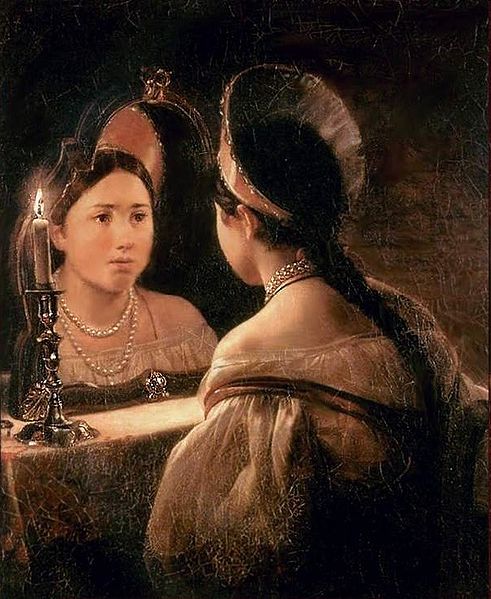
Picture, an illustration to Zhukovsky's poem: Karl Brullov, Svetlana's Magic Fortunetelling, 1836, o/c, 94 x 81 cm, Art Museum of Nizhny Novgorod.
Special thanks to Languagehat for the prompt to make this post.
Katia Zatuliveter has been in the news in Britain for months, but presenters and newsreaders still stumble over her seemingly un-Russian looking/sounding surname.
However the name's semantics are perfectly Russian and follow the pattern of many other compound surnames.
It consists of two parts zatuli- and -veter. The second part is clear enough – veter is wind.
The first is formed with the common root -tul- (-тул-, similar words: втулка - insert, притулиться - to huddle, сутулиться - to stoop one's shoulders) and equally common prefix za- (за-). The verb затулить is in many larger Russian dictionaries, including the largest one, the Dahl dictionary. Its general meaning is to cover, to shelter. Dahl gives this folk rhyme: Не велик муженек (хоть плох мужичек), да затулье мое: завалюсь за него - не боюсь никого! – My man may not be big, but he's my shelter/cover (zatulye), I fall behind him – and I'm afraid of noone.
Whatever her morals, at the appeal hearings she produced a wonderful adlib (BBC report here). In response to an allegation that her relationship with Mike Hancock, MP, was based on sex, she said: "I don't know how people usually have relationships but when I have a relationship, it's based on communication."


 (link to Amazon) is a story of a young Jewish Russian girl Inna Feldman whose relatives flee to Palestine and abandon her in the South of Russia, within the Pale of Settlement. It is 1911, the Russian tsardom feels it has re-established its authority over the Empire after the turmoil and hope of the first revolution of 1905-1907. And it smells of pogrom everywhere.