(Lord Sumption on Boris's 'hammer and sickle' attitude)
In the UK, on the eve of the Supreme Court hearings on two challenges to Boris Johnson's decision to prorogate (suspend) the Parliament, a prominent lawyer Jonathan Sumption QC used a loaded metaphor to describe the situation. On BBC television's Newsnight programme he said:
"If you behave outrageously and defy the political culture on which our constitution depends, a lot of judges are going to be tempted to push the limits out.
"Boris Johnson has taken a hammer and sickle to our political culture in a way that is highly provocative to people who believe that there ought to be solutions consistent with our traditions."
Now, hammer and sickle, of course is a well-known communist emblem. It originated early in the Russian Revolution, roughly at the same time as swastika was being adopted by the nazis in Germany. Today, it is still in wide circulation in Russia and remains in use in the remaining communist countries but banned in many others as the symbol of brutal totalitarian oppression.
Which makes Lord Sumption's application beautifully apposite. He says, in effect, that Johnson is disregarding the delicate constitutional setup of Britain. Disregarding it to the point of destruction in a bolshevist manner, applying the 'hammer and sickle'.
While this meaning is widely known in the West, few would know, I think, another Russian idiomatic expression with the sickle — пройтись серпом по яйцам, take a sickle to the balls. It may not be for a polite company, but basically means the same as in the above quotation by the Right Honourable Lord Sumption, to harm someone, to damage, to assault brutally, literally — to castrate.
Which, to finish this, may be added to the notebooks of those who see the hammer and sickle as a Dan Brownesque sexual symbol, hammer for man, sickle for woman.
Here is a clip from Newsnight's Twitter with Lord Sumption's quote. (Watch a longer, more detailed 2 min video of the interview is on The New European site)
“If you... defy the political culture on which our constitution depends, a lot of judges are going to be tempted to push the limits out." Lord Sumption says “Boris Johnson is taking a hammer and sickle to our political culture in a way that is highly provocative.”#Newsnightpic.twitter.com/96ac9vA3Cy
Evgeny Yevtushenko, a leading Russian poet of the 60-s generation, died on 1 April 2017, aged 84.
He was a prominent voice of his generation and a controversial, much spoken of figure of later years. Much is being said about his personality and political face. Tetradki want to let you simply listen to him reciting his own poetry.
Here he is, in the 1965 film "I am Twenty" by Marlen Khutsiev (Wikipedia about the film). It is a long semi-documentary sequence of a poetry reading in the Moscow Polytechnic Museum lecture hall, a popular venue for intelligentsia gatherings at the time. (Yevtushenko is the first reader in the episode)
All British football fans know the Match of the Day musical theme. In fact, every British knows it. It is so ubiquitous, so well known that it is associated with football in general. Match of the Day, the BBC TV programme itself is one of the longest running. It's begun over fifty years ago, in 1964. The musical theme, however, was composed only in 1970 especially for Match of the Day by Barry Stoller.
Russians have their own football theme called the Football March ("Футбольный марш", wikipedia in Russian). It was composed in 1938 by Matvey Blanter, one of the most prolific Soviet musicians. The march is in E-flat major. It opens with a vibraphone (similar to xylophone) jingle, that is often used separately on radio and TV, and then the full brass orchestra steps in triumphantly.
The melody is still used throughout the former Soviet Union, not just Russia herself. Blanter is, perhaps, most famous for the iconic 'Katyusha', also composed in 1938. According to chess grand-master and musician Mark Taimanov, in his study, Shostakovich, who was the first to listen to the Football March, had a Blanter's portrait hanging next to the one of Beethoven.
(first from right, no relation to the editor of Tetradki).
Republished by permission.
Watch a Russian TV programme about the Football Match story here, in Russian, in Russian with vintage footage.
Here is the full version of the Football March, followed by a 1955 animated film 'A Marvelous Match' ("Необыкновенный матч") with a version of the Football Match theme played from 9:55 minutes into the film.
Football March theme is at 9:55 min into the film —
The Irony of Fate, or Enjoy Your Bath! is a two-part TV film that has been a New Year's must in Russia for over thirty years since it was first broadcast on New Year's Day in 1976.
"The comedy born by the director Eldar Ryazanov is the most loved film of all Russia, — writes Lurkmore.—It is also an object of unbridled adoration (~) of all who are nostalgic for everything Soviet and the Soviet way of life. Every New Year from the time of its release the film is shown on at least one and sometimes several TV channels [in Russia]. Anonimus remembers an occasion when the film was on on three main TV channels at the same time (but staggered, not synchronised.) On New Year's night, it has become a good tradition in true Russian families to contemplate this example of the art of cinema with vodka-heavy eyes and a mouthfuls of festive olivier salad (because it will be off the next day.) A whole generation of citizens has grown and matured who have been watching The Irony of Fate from age two. They can imagine the holiday without the film no more as without the chimes of the Kremlin clock tower, olivier and hellish hangover on the morning of the 1 January. And they successfully instill the beautiful tradition in their children."
Dialogues in the film are in a perfectly correct Russian, to the point of being bland. This makes it a good aid for language lessons.
The songs, all of which have become national hits, are to the poems by Yevgeniy Yevtushenko, Marina Tsvetayeva (two), Bella Akhmadulina, Boris Pasternak, Alexander Aronov, Vladimir Kirshon and Mikhail Lvovsky. They are sung by Alla Pugachyova and Sergei Nikitin.
Here is the film in full with English subtitles.
(Episode 1, from the official Mosfilm YouTube channel)
A friend reminded me about this song today. Because Manchester City plays Liverpool and he is a great football fan and a great francophile.
Me, I have been boycotting football ever since the brilliant Dutch side of Johan Cruyff lost in the final of 1974 World Cup to the cautious bores of Franz Beckenbauer. I decided then that there is something wrong with the game and nothing has prompted me to change my mind since.
But I am not writing about footbal. 'Manchester and Liverpool' is a song that had served as the background music to the weather forecast at the end of 'Programma Vremya' (Time), the main Soviet TV news programme at 9:00 PM.
Just imagine: 250 million people had listened to this same tune day after day for more nearly twenty years!
Few knew what it was, it was just an instrumental piece. I was surprised to learn it was foreign when my father, who had just returned to Moscow after a long stint abroad, told me its title.
I am not sure why this particular melody was chosen for the Soviet weather forecast, some TV boss must have been smitten by the French film star and folk-pop singer Marie Laforêt.
But it's a lovely song and still touches nostalgic strings in the hearts of former Soviet citizens.
The opening music was Georgi Sviridov's triumphant 'Time, Forward'. It is still the signature tune for 'Vremya.'
Here is Marie Laforêt singing her 1967 hit:
And here is a sample weather forecast at the end of 'Vremya':
Russia marks Victory Day today known as VE Day in Britain and Victoire in France.
In the past years the holiday has been built up in Russia as the day of national pride. A drumbeat of patriotic pomp and circumstance accompanies parades and celebrations in Moscow and throughout the country. (Wearing St.George's ribbon badge for Victory day was introduced in 2005. The gold and black are traditional colours of the Russian Empire.)
The literary and musical legacy of the Great Patriotic war, as world war two is known in Russia, is truly amazing.
Contemporaries and historians note, however, that real hits that soldiers and families took to heart were not the patriotic marches and songs of military feats but lyrical numbers, songs about love and personal loyalty in the face of death and separation.
The war also partially opened up Stalin's Soviet Union to Western pop culture.
In 1943 Leonid Utyosov, the popular singer and musician, released his version of the American song Comin' in on a Wing and a Prayer, by Harold Adamson и Jimmie McHugh, a number 1 hit in 1943. In Russian it was called Bombardirovshiki – The Bombers. The lyrics were written by T.Sykorskaya and S.Bolotin who kept the words close to the English original.
They changed the key line in refrain, though, from 'on a prayer' to 'on the word of honour' – na chestnom slove. This Russian idiom means 'only just managing', 'just holding on', in poor condition. Translators' find also avoided the religious reference that would have been frowned upon in Soviet times.
In this video Utyosov sings Comin' in on a Wing and a Prayer with daughter Edith. The footage is from the US film Memphis Belle. In the Russian version of Tetradki I publish a video with both English and Russian versions of the song superimposed over footage from the same film.
And this is a country style take on the song in a very smokey 1997 video version by the Russian group Chizh and Co.
Svetlana Alliluyeva, Stalin's daughter, died on 22 November 2011. She had a long and, at times, troubled life. A Kremlin princess until Stalin's death in 1953, in 1967 she defected to the USA, an event that was a big propaganda coup for the West. (see video below, wiki about her here).
There is a persistent myth linked with her name. At least I think it's a myth. The myth that there was a Soviet perfume named after her.
It was probably started by an American journalist's mention in the 1950s feature and found its way into other publications, including serious studies of Russia, and in a bounce-flash, is now mentioned, as fact, in Russian press. (See this article, which also includes videos about Alliluyeva.)
One blogger's obituary says: 'Growing up, she was a beloved celebrity in her home country. Thousands of girls were named after her. So was a bestselling perfume.'
The obituary links to an article from Russia by the AP Women's Editor Dorothy Roe. It is dated December 1957 and says: 'Just recently Russia started manufacturing perfume, the most expensive and prized of which is called 'Svetlana's Breath' – Svetlana is Stalin's daughter, you know'.
The American article is uncomplimentary about conditions of life for Russian women. But the correspondent obviously did an honest job walking around, observing and interviewing people. The year 1957 was an exciting time in Russia. Khrushchev has just denounced Stalin's crimes, Sputnik was launched and the International Youth Festival created an atmosphere of incredible openness and optimistic outlook. Khrushchev and Eisenhower were looking for a way to end the cold war.
The Moscow perfume factory, 'Novaya Zarya' – New Dawn, founded 1884, (link to their official web-site, small wiki article in Russian here), did indeed make a perfume called 'Svetlana', not 'Svetlana's Breath'. It is mentioned, for example, in this overview of the factory's products as one of its top quality brands. Either the correspondent misunderstood the name of the brand, or the interviewee made a joke about Stalin's personality cult that was lost in translation.
The trap here, for a translator – and a journalist, is in the word дух – spirit, ghost, which also means smell, scent. In fact, Pushkin played on the word in the introduction to the poem Ruslan and Lyudmila: "Там русский дух, там Русью пахнет" – "there is the Russian spirit, it smells of Russia there". Dahl's dictionary (словарь Даля), the biggest collection of Russian words, gives the whole range of meanings in an article on дух(link to Vasmer's etymological dictionary on dukh, which in turn links to major Russian dictionaries, click on Dahl). Дух is cognate with душа (soul) and дыхание (breath) but духи in plural with the stress on the last syllable has only one meaning – perfume.
The name of the perfume, after Khrushchev's 1956 denunciation of Stalin, is unlikely to
have been linked to Svetlana Alliluyeva, but, I am almost sure, is a reference to
'Lullaby for Svetlana', a hit number from the musical "Давным-давно" – 'Long Time Ago'
(play by Alexander Gladkov, music by Tikhon Khrennikov). In 1962 Eldar Ryazanov made a film version,
"Гусарская баллада" ('The Hussar Ballad). Svetlana is the name of the doll belonging to the main character Alexandra (Shurochka). She sings the lullaby 'Sleep, my Svetlana' before
running away from home to join, disguised as a hussar, the Russian army
fighting Napoleon in 1812.
The play was written in 1941, just before Hitler's invasion of the Soviet Union, and staged for
the first time in 1942 in Sverdlovsk (now Yekaterinburg), where many Moscow organizations
were evacuated. Scenes and musical numbers from the play were broadcast over the national radio. It has remained a signature production for the Central
Army Theatre in Moscow ever since. Its patriotic theme was apt for the time and the catchy tunes are still, seventy years on, popular.
My
grandmother and mother, a little girl then, were also evacuated to Sverdlovsk – and my mother had
a doll there called Svetlana. That's where my sister later got her name from. I didn't
know about the doll, mother only told me the other day when I mentioned the death of Svetlana Alliluyeva. My mother doesn't remember the perfume, nor the play from those times, but she and my grandmother
may have seen it then.
The name Svetlana in the play might have been 'inspired' by Stalin's
daughter, but would have been linked to the poet Vasily Zhukovsky's 1808-1812 romantic
ballad 'Svetlana' based on Gottfried Burger's Lenore (wiki on Lenore). Zhukovsky
did another version of Lenore titled 'Lyudmila'. Both Svetlana (meaning the Light One) and
Lyudmila (Beloved by the People) remain two of the most popular pre-Christian Russian women's
names. It is possible that Stalin's daughter was named after Zhukovsky's heroine. While 'thousands of girls named after Stalin's daughter' is obviously what was happening at the height of his cult, the name had its own life, separate from Stalin.
Stalin's daughter or not, the lines from Zhukovsky's ballad "О, не знай сих страшных снов, Светлана" – 'Oh, never shall you know those terrible dreams, Svetlana' are widely known, and during the Stalin period would have had certain reverberations – abduction, having a dead man for a groom, trying to figure out your fate and then waking up from a bad dream.
Novaya Zarya has a long tradition of giving their perfumes women names with romantic connotations. In the 70s one of the popular brands – which I remember buying myself – was called 'Natasha', possibly after Tolstoy's Natasha Rostova. One of their current brands is 'Yelena'. My theory about 'Svetlana' perfume could only be confirmed by evidence from the Novaya Zarya archives or by someone who remembers how the name was assigned. For now, I simply offer this as a theory.
The Hussar's Ballad can be seen on YouTube in full. The lullaby scene begins at 22 min. (Embedding is disabled, copyright is owned by Mosfilm). RuTube has a clip with the lullaby:
Here Svetlana Alliluyeva speaks at the press-conference after her defection in 1967:
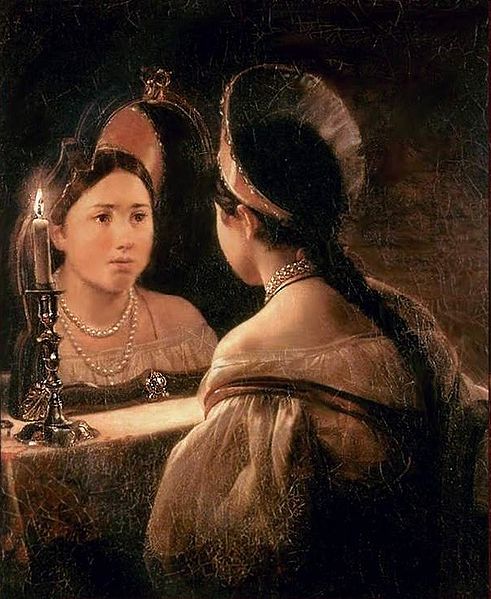
Picture, an illustration to Zhukovsky's poem: Karl Brullov, Svetlana's Magic Fortunetelling, 1836, o/c, 94 x 81 cm, Art Museum of Nizhny Novgorod.
Special thanks to Languagehat for the prompt to make this post.